
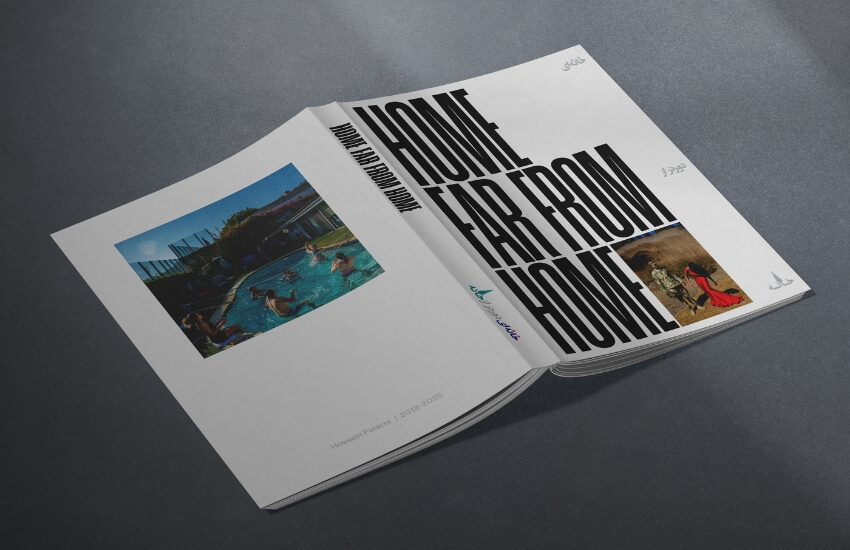

Home Far From Home documents the immigrant experience through design and photography, offering a powerful meditation on identity, displacement, and resilience. In this interview, Alireza Vaziri, graphic designer and assistant professor at the University of Maryland, discusses how he used thoughtful typography, poetry, and layout to support Hossein Fatemi’s poignant photography.
Award: Creative Communication Awards Winner, Art & Culture Books
Project: Home Far From Home
Lead: Alireza Vaziri
Alireza Vaziri: I am a graphic designer and assistant professor at the University of Maryland, with an MFA in Design from UC Davis. My scholarship, teaching, and creative practice focus on using visual storytelling and interactive media to address contemporary social, political, and cultural dilemmas. Whether designing a book cover, poster series, or an AR project, I aim to create meaningful visual narratives. Over the years, I have worked on projects at national and international levels, always striving to bridge emotion and communication through design.
Alireza Vaziri: The project aimed to document and visually interpret the stories of Iranian immigrants in the U.S. over the past five decades. As art director, I was tasked with designing a book that complemented Hossein Fatemi’s photography while adding my own creative perspective. The goal was to use thoughtful design to foster empathy, providing viewers with a nuanced portrayal of the immigrant experience through visual storytelling.
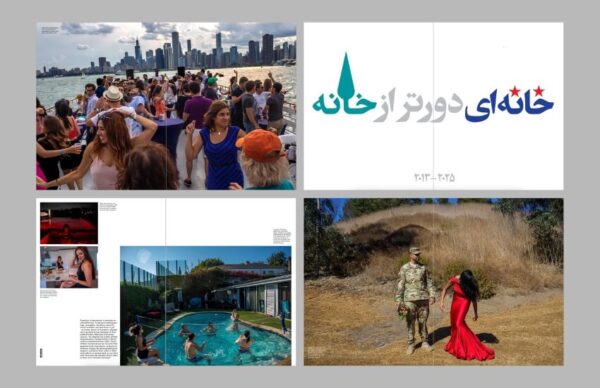
Alireza Vaziri: Home Far From Home serves as a memoir in a tangible form, allowing readers to engage with specific moments in immigrants’ lives. It explores passion, survival, resilience, and the dynamics of attachment and detachment. The book illuminates the silent anguish beneath the glory of freedom, unique tales yearning to be heard. Each photograph resonates with the significance of these journeys, inviting reflection on the immigrant experience. My own journey and emotions tied to leaving one’s homeland provided the inspiration for this cultural archive.
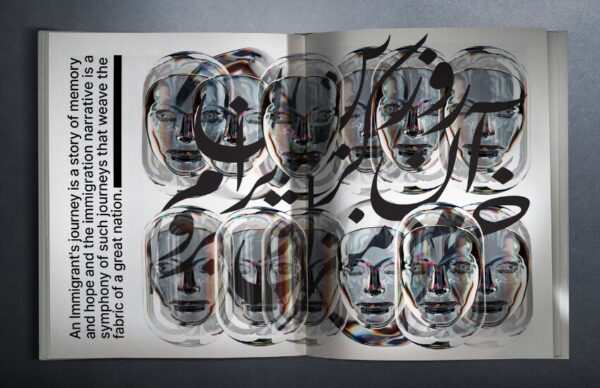
Alireza Vaziri: One key challenge was designing an art book rather than a simple photo book. I used typography, poems, and illustrations to complement Fatemi’s images without overshadowing them. Balancing photography and graphic design required immersion in the narrative’s emotional arc. My passion for poetry helped convey the message concisely; every few pages features a Persian poem about “home,” drawn from ancient and contemporary poets.
Alireza Vaziri: I have always loved design and see it everywhere, from a simple cup to a movie title. This passion, rooted in my appreciation for beauty in form and concept, became second nature. Early in my career as a creative director in Iran, I learned the importance of understanding commercial and cultural contexts. Collaborating on global projects and transitioning into teaching broadened my perspective, enabling me to merge traditional and contemporary methods for impactful work.
Alireza Vaziri: As an educator, I stay informed through publications, podcasts, books, conferences, and hands-on experimentation with tools like AI. I see AI as a dance partner, enhancing discovery and efficiency. However, like Paul Virilio said, every technology carries risks: when you invent the ship, you also invent the shipwreck. It is crucial to use AI thoughtfully to amplify human creativity while being mindful of its implications.
Alireza Vaziri: Growth comes from constant learning and curiosity. Teaching challenges me to stay sharp, as students bring fresh perspectives. I dedicate time to reading, listening to podcasts, watching lectures, experimenting with new techniques, and collaborating on projects. Reflecting on my work and embracing feedback refines my skills and fuels my passion.
Alireza Vaziri: Inspiration comes from everyday life, personal experiences, and cross-disciplinary exploration. Art, literature, and travel are vital sources. Living near Washington, DC gives me access to world-class museums, which have inspired me since childhood. I nurture creativity by sketching, designing, speaking with peers and students, and giving myself freedom to experiment without immediate expectations.
Alireza Vaziri: I admire Stefan Sagmeister for his bold visual storytelling, Abbas Kiarostami for evoking raw emotion through cinema, and Pentagram Studio for setting a global standard. Paula Scher and Matt Willey at Pentagram are also incredible sources of inspiration.
Alireza Vaziri: Design is a collaborative process. By understanding clients’ goals and challenges through open dialogue and mutual respect, I deliver work that meets their needs while incorporating my creative perspective. Now I choose projects where I can make the most meaningful contributions, such as this book, where my connection as an immigrant drove me to enrich the concept.
Alireza Vaziri: This award is an incredible honor. It validates the passion and effort poured into the book and underscores the importance of visual storytelling in addressing global issues. I am humbled to contribute to a project that resonates with the Iranian American community and beyond, and I am especially grateful to the Clarvit family and the University of Maryland Department of Arts for their unwavering support. Their encouragement has been invaluable, allowing me to focus deeply on projects like “Home Far From Home” and grow as a creative professional.
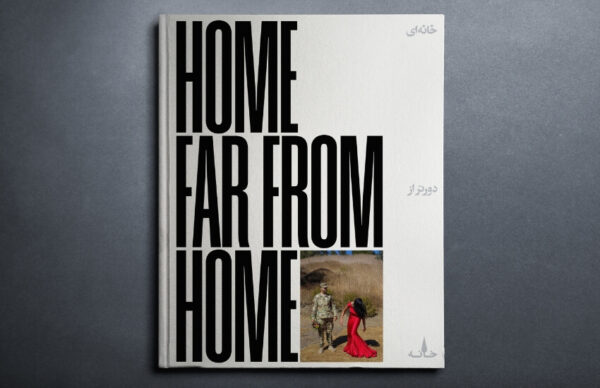
Home Far From Home shows how thoughtful design can foster empathy and preserve cultural memory. By weaving typography, poetry, and photography into a cohesive narrative, Alireza Vaziri has created a tactile archive that honors immigrants’ journeys and invites readers to reflect on the meaning of home.